
Freethought-Now

I was so sorry to learn recently that FFRF’s first “Freethinker of the Year” died two years ago. His death was only locally reported. But Ishmael Jaffree was a Supreme Court Establishment Clause victor and national hero whose life and achievements should be known and celebrated.
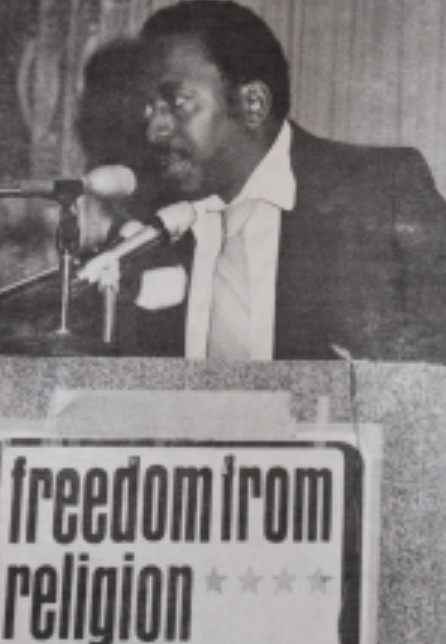
In fact, the Freedom From Religion Foundation, way back in 1985, created our “Freethinker of the Year” award, which recognizes activists who bring and win state/church litigation, just for HIM. He had spoken at our 1982 national convention when he initially started his court challenge of school prayer practices and a prayer law in Alabama. When his legal fight reached the U.S. Supreme Court and resulted in a resounding ruling in his favor, we knew we needed to give him and other activists like him very special recognition.
As my father, Paul (“Jody”) Gaylor, said in introducing Jaffree at our 1985 national convention in Minneapolis, “It took a great deal of courage and tenacity for Jaffree to start his case and carry it through the courts for four years.” My father was usually happy working behind the scenes, taking photographs that documented FFRF’s early days and serving as number-one volunteer. However, admiring of Jaffree’s achievements, he made a rare request that year to be allowed the privilege of introducing the new award and its remarkable first recipient.
Jaffree was a Legal Services Corporation attorney in Mobile, Ala. He was born in Cleveland on March 28, 1944, as Frederick W. Hobbs. As a child, he evangelized on Cleveland street corners, “exhorting sinners to get right with God,” according to a People magazine story (June 24, 1985).
He attended Cuyahoga Community College and Cleveland State University and battled his way into Cleveland-Marshall Law School. At Cleveland State, he was influenced by a Black atheist professor named Jaffree. He shed what he considered his slave name to become Ishmael Jaffree. “I started considering myself an Existentialist. I no longer believed the Christian faith was the faith and that Jesus Christ had blue eyes and white skin,” he told People magazine. At his speech at the 1985 FFRF convention, Jaffree said he realized he’d been conditioned to judge people “by what they believe, and not by what they are.” He called himself an agnostic and noted that the term agnostic probably saved him some extra harassment because the Mobilians thought that was some kind of a religion!
He married a Baha’i follower and got her to agree to a pact: She would not try to inculcate their children with her religious beliefs if he would not inculcate them with his nonbelief. “We would wait until they were old enough to understand the difference between fact and fiction, fact and fantasy, understand esoteric concepts such as a belief in a god or the nonexistence of a god, and let them choose for themselves,” he explained in his acceptance speech (published in Freethought Today, November 1985). “So you can imagine how incensed I was,” he added, “when I learned from my little 5-year-old that his school teacher was leading the class in various forms of Christian-oriented religious practices in the public schools.”
At the time the legal fight began in 1981, the couple had five children, later having a sixth. He discovered that two of his other kids were also being fed daily doses of the Lord’s Prayer and grace at lunch, and an occasional bible reading. He took his complaint through the proper channels, protesting the practice first with teachers, then principal, then superintendent. When he got no results, he sought action in the federal district court, filing suit in May 1982, about a year after he first started addressing the violation.
In response, Alabama Gov. Fob James endorsed school prayer at a statewide news conference in June 1982, then introduced legislation authorizing teachers to lead classes in prayer and meditation. The law passed about seven or eight days later. The law’s language even included a prayer written by the governor’s son, Fob James III, which began: “Almighty God. You alone are our God. We acknowledge You as a Creator and supreme judge of the world. May your justice, your truth and your peace abound this day.”
Jaffree added that law to his challenge, along with a 1981 silent prayer law, plus a suit against the teachers. As my dad put it in his introduction, “He sued just about everybody.”
Jaffree had very bad luck because the (misnamed) Judge Learned Hand, a rabid born-again, was chief judge, and assigned himself the case, taking it over from another judge. However, following Supreme Court precedent, Hand initially did enjoin the statutes. After Hand’s ruling, the governor told teachers to do whatever their hearts dictated with respect to religion. Jaffree and his attorney tried but failed to hold the governor in contempt. Receiving no support from the ACLU or even the local Unitarians, Jaffree persevered in his costly challenges.
During the November 1982 trial — and over the objections of both sides — Hand allowed over 600 people to intervene and essentially take over the trial, alleging the so-called evil religion of secular humanism was being taught in the schools. The trial became a circus. A series of ministers with area radio programs testified against secular humanism, which, during the 1980s, was a favorite punching bag of the religious right. A string of so-called experts testified that the Supreme Court was in error when it decided the Schempp case against bible reading and recitation in the schools. In the end, Hand handed down an infamous decision, siding with the intervenors. Hand insisted that states could go their own way and establish the religion of Christianity or any religion they wanted to, the Constitution be damned.
After that decision, some of the school officials and the teachers in Mobile had what Jaffree called “a field day”: “They called the media in and led children in prayer right in front of the media. My children started crying because their teachers immediately reinstituted the practice of prayer during the public schools.”
His children had been distressed about the case because, of course, they lost their friends and were persecuted. There was massive harassment of this brave Black family living in a mostly white neighborhood in Mobile. Jaffree had promised the children that he was going to win the case, “and here they were forced to endure not only the humiliation from their classmates but sit and listen to the teacher instructing the class on some form of religious activity.”
He and his attorney immediately asked the 11th U.S. Circuit Court of Appeals to issue an injunction to enjoin Hand’s decision. The circuit refused, so they appealed to Judge Lewis Powell on the Supreme Court, who issued an injunction. Ultimately, the appeals court ruled in his favor. The Supreme Court granted cert on one part of the case and agreed to hear the silent meditation part. “We sold Justice [Sandra Day ] O’Connor on the idea that the state, at the very least, in sponsoring the silent meditation for prayer statute, when they already had in existence a silent meditation statute, was clearly giving the appearance of sponsoring religion,” Jaffree noted. O’Connor became part of the 6–3 majority decision in Jaffree’s favor, handed down on June 4, 1985.
Unbelievably, even after this ruling, Hand took steps to keep alive the phony lawsuit against secular humanism, which held up Jaffree’s attorneys’ fees and costs that totaled more than $10,000 then (about $30,000 today). When the 600 plaintiffs pursued a suit against the school board, Jaffree fortunately was able to extricate himself from that continuing challenge.
An FFRF member asked Jaffree at the convention if he’d do it all over again. Yes, he replied, “I would do it because I’m absolutely committed to the idea of separation of church and state. There’s no question that my religious view is a minority, and unless people like me are willing to challenge these cases, then we don’t have a chance.”
Jaffree died at age 80 on July 30, 2024. His online obituary noted that he “truly lived a life of no regrets.” Even if you set aside his freedom of conscience heroism, Jaffree was an exemplar. In practicing law for over 45 years, he represented thousands of indigent and poor clients. His obituary mentioned, “He was, above all, a freethinker, reveling in his tendency to go against the grain. He was passionate about two things — helping the poor and his loving family.” He left behind his wife of 49 years, Mozelle Jaffree, their six children and six grandchildren.
When Dan and I managed to chase down Ishmael Jaffree 32 years after his appearance at our conference and interviewed him remotely for our radio show on April 17, 2017, we asked about his children, who had gone through so much. He told us that all six had come to take some pride in their father’s fight and proudly recounted how they were all high achievers and included two attorneys and a physician.
Dan quipped at the end of the interview how very appropriate it was that Jaffree’s last name ends with “free.” He replied, “I am the ultimate freethinker in the whole state!”
He was truly a quiet and unsung freethought hero. His legacy must be remembered and revered.
The post Freethinker Ishmael Jaffree In Memoriam — A champion of the First Amendment appeared first on Freethought Now.
Leave a Reply