
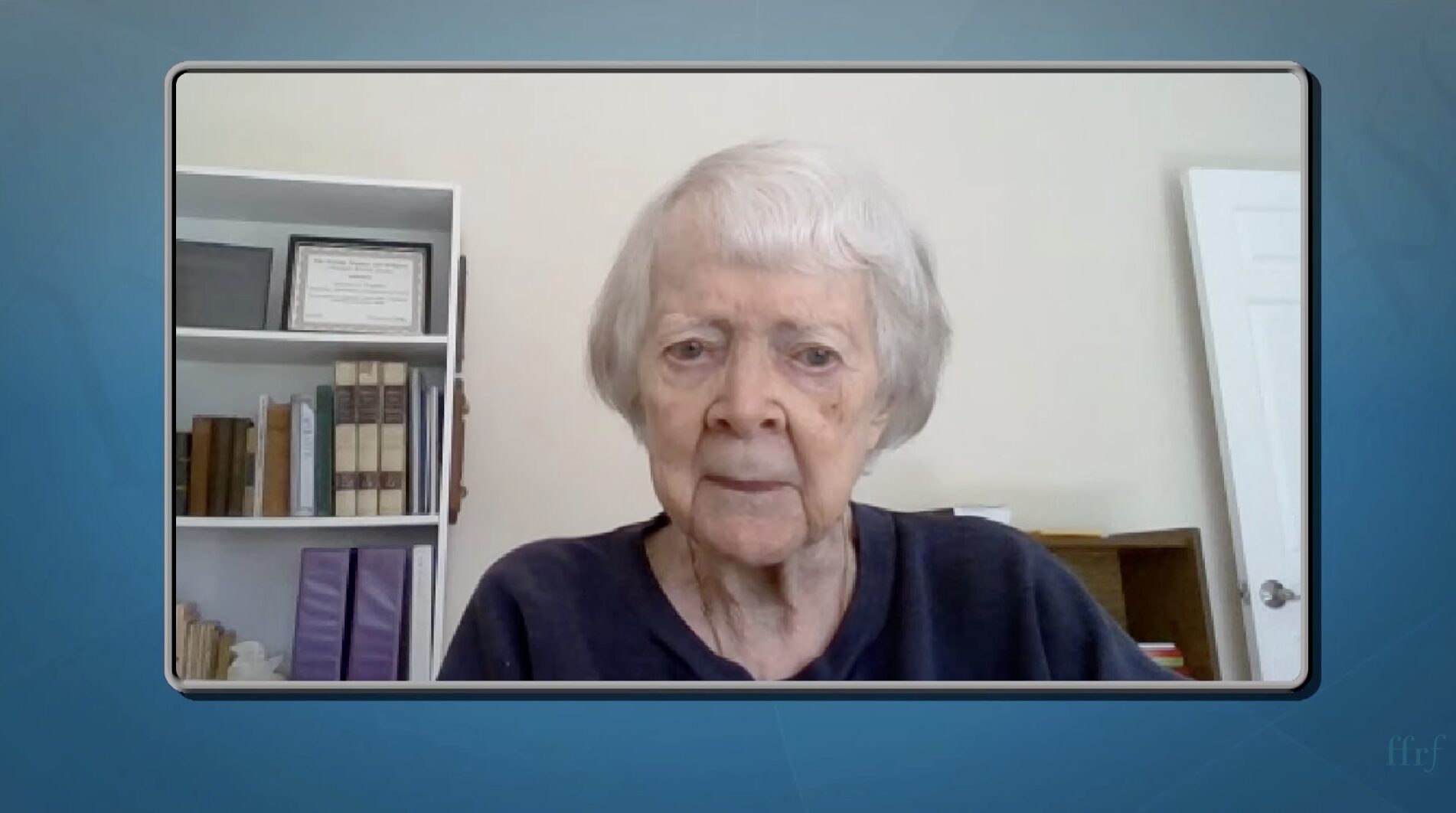

FFRF Lifetime Member Barbara G. Walker — a prominent feminist and freethinker — died at the age of 95 late last month.
Barbara was the notable author of the monumental “The Women’s Encyclopedia of Myths and Secrets” (1983), known to almost all feminists of that era, whose goal was to trace the “transition from female-oriented to male-oriented religions in Western civilization.” As a connoisseur of facts on the origins of religion as well as paganism, I feel sure that Barbara would have been quite all right about dying on the Winter Solstice.
Barbara originally was known as a knitting expert, writing classics such as “Treasury of Knitting Patterns.” Then she became the famed author of the bestselling “Woman’s Encyclopedia” and at least 26 other books, including on feminism and freethought, with titles such as “The Skeptical Feminist,” “Man Made God,” “Belief and Unbelief” and “Feminist Fairy Tales.”
The Freedom From Religion Foundation was honored that many of the columns that became the chapters of “Man Made God” were first published in our newspaper Freethought Today. We published several of her pieces, with titles such as “Subjugation of women entirely based on religion,” “Religion is the world’s greatest scam” and “How patriarchal religion suppressed sexuality.”
I included a chapter on Barbara in the 1996 anthology, “Women Without Superstition: No Gods — No Masters,” published by the Freedom From Religion Foundation.
I first met Barbara in May 1993, when, as co-chair of the Feminist Caucus of the American Humanist Association, I introduced her at AHA’s conference in Philadelphia to receive the annual “Freethought Heroine” award. I was charmed by her talk. (More on that later.)
We spoke and corresponded periodically through the years, usually about her submissions to our newspaper. The last time I talked at any length with Barbara was in 2022, when I interviewed the nonagenarian for our former TV show, “Freethought Matters.” I had been impressed that she was bicycling in her retirement community in Florida. Chatting before the interview, she informed me somewhat sadly that she’d had an injury and had to give up outdoor bicycling. But Barbara was chipper and, as always, poised, articulate and endlessly quotable in telling it like it is about religion. (View the episode here or look it up at Freethought TV, FFRF’s free app for smart devices.)
After her son thoughtfully informed me about her death the same day she died, I looked up that interview. Watching it, suddenly I remembered how we’d had to delete an amazing remark made while debunking the underpinnings of Christianity. It contained the “f” word. To quote Barbara: “And then I was told also that God and his son are one and the same. They’re both the same god, same person. So that made Mary the mother of one and the bride of the other and they were both the same person. So that made God the original mother fucker.”
These true words coming from the mouth of this sedate, white-haired, elderly woman broke our crew up after the recording was over. If you watch the deleted clip, you’ll see my face fall — because all I could think was that we’d have to edit it out, since the show was broadcast on some 13 TV stations around the country at the time. So that’s what we did.
However, after remembering this astonishing moment, I immediately contacted our video director, Bruce Johnson. He was on vacation at the time, and his reply tempered my expectations, saying he usually didn’t retain outtakes. But Bruce promised to check. It made my month when he found it was somehow still in his files. FFRF has uploaded the footage to YouTube. I am so pleased FFRF can resurrect Barbara’s pithy pronouncement, which, besides being unforgettable, has the benefit, as she logically shows, of being true.
Barbara was full of pithy pronouncements. During the 2022 interview, I asked her to recount my favorite anecdote, from her Humanist Heroine speech, which is reprinted in full in “Women Without Superstition” and is called “The Skeptical Feminist.” In this talk, Barbara explained that she became a skeptic very young, after her dog died and her minister told her that dogs don’t go to heaven because they have no souls.
At this, Barbara stamped her foot and said, “I don’t want anything to do with your rotten old God and nasty old heaven.” She continued, “I entered Sunday school [and there] was a life-sized crucifixion scene with a lot of agony and twisted muscles and it was horrible. I was told that God had decreed that this had to be done to his dearly beloved son. . . . And then we children were taught that not only was this poor man tortured on the cross but we had to become cannibals and eat him. . . . I began to think in my childish way that the God who decreed all of this was some kind of a lunatic.”
Barbara also wisely noted in that talk, “Every psychologist knows that childhood fears eventually become adult cruelties and/or dysfunctions. Being forced into unnecessary fear is not really the best route to mental health and confidence in adulthood. On the contrary, the very fears and guilts imposed by religious training are responsible for some of history’s most brutal wars, crusades, pogroms and persecutions. . . . History doesn’t say much very good about God.”
At 12, Barbara found her first love, astronomy, studying stars through her telescope every night. Then came a “horse phase,” interrupted by a major in journalism at the University of Pennsylvania. She married research chemist Gordon Walker, moved to Washington, D.C., and worked at the Washington Star. After relocating to New Jersey, this multitalented individual taught the Martha Graham dance technique.
She subsequently fell into knitting, innovating exciting new methods and writing 10 books on the craft, including the classics, “Treasury of Knitting Patterns” and “A Second Treasury of Knitting Patterns.” Vogue Knitting once declared that “knitting without them is like writing without a dictionary.”
In the mid-1970s, she worked at a local hotline for women, and soon set out on her second career as a feminist/skeptical writer.
I often feel that no public figure has been properly memorialized until their obituary runs in The New York Times. With kind help from a former writer there, I contacted the obituary department in case the people there didn’t know about Barbara. I sent them a link to a memorial that had run in a knitting magazine, but supplied plenty of information about Barbara’s second profession — her skeptical writing. While her knitting achievements are phenomenal and deserve lots of copy, I was crushed that the Times, in its lengthy piece, devoted less than a short paragraph to her feminist and skeptical writings. At least it did reprint the cover of her book, “The Skeptical Feminist.” If you go online to read the obituary, it’s still really fun to see the color photos of Barbara modeling many of her famous stitches and creations.
“I feel satisfied with my life and glad to have contributed to the creativity of so many other people,” Barbara wrote for Piecework magazine. “I have been one of the fortunate ones, to have found fertile niches that challenged my mind, heart, and hands, and lived in them with joy.”
Wanting her work to live after her, Barbara arranged to share these thoughts with FFRF and the world at: http://bgw.works/
The freethought and feminist worlds have lost a major player, but Barbara has created an important legacy, not just through her stitches, but also through her scholarship and plain-speaking about religion.
Leave a Reply