
Freethought-Now

This week had everything: a taxpayer-supported Christian nationalist rally on the National Mall, a public school prayer protest in Arizona, another Trump administration attack on dissent and FFRF showing up everywhere from national media to late-night television.
Here’s what happened this week in the ongoing fight to keep religion out of government.
FFRF made a late-night appearance during Colbert’s farewell

Last night marked the final episode of “The Late Show with Stephen Colbert” — and FFRF was part of the sendoff.
During the finale, FFRF aired its iconic Ron Reagan ad (“unabashed atheist, not afraid of burning in hell”), bringing a message of freethought and secular government to one of television’s biggest cultural moments.
There was something oddly perfect about it.
For years, Colbert used satire, absurdity and sharp political commentary to expose hypocrisy and puncture authoritarianism. At a moment when Christian nationalism increasingly demands cultural dominance alongside political power, it felt fitting that unapologetic secularism showed up for the curtain call, too.
And in a media environment where nonreligious voices are still often treated as niche or controversial, simply appearing in a major cultural broadcast matters.
Trump’s prayer rally was supposed to project unity — Instead, it exposed the agenda

The Trump-backed “Rededicate 250” rally on the National Mall was marketed as a patriotic spiritual gathering ahead of America’s 250th anniversary.
In practice, it looked a lot more like a taxpayer-supported branding exercise for Christian nationalism.
And the criticism wasn’t isolated.
Coverage mentioning FFRF’s protest or concerns poured in from major national and international outlets, including:
- Reuters highlighted concerns over the blurring of church and state.
- USA Today published an opinion piece arguing the rally’s evangelical focus was fundamentally un-American.
- Associated Press documented thousands gathering for the event while critics warned about Christian nationalism.
- Mother Jones framed the rally as part of a broader effort to brand America’s 250th anniversary as explicitly Christian.
And perhaps most tellingly, even much of the coverage about the rally centered less on “national unity” and more on concerns about exclusion, religious favoritism and government-backed evangelical politics.
Because that’s the contradiction at the center of these events:
You can’t claim to celebrate religious liberty while using government power to privilege one religion over everyone else.
The mythology behind the movement
One of the most revealing pieces this week came from The New York Times, which examined how the famous image of George Washington praying at Valley Forge has become a powerful symbol in modern Christian nationalist politics.
The article traces how the painting — based on a story that historians largely regard as legend rather than fact — is increasingly being used by Trump-aligned groups and America 250 events to promote the idea that the United States was founded as an explicitly Christian nation. And shows how FFRF has helped correct the historic record.
That matters because this movement depends not just on policy, but on rewriting history itself.
As the article notes, Washington may have been personally religious, but he also strongly supported religious liberty and opposed religion becoming “a state project.”
Want to keep up with all of FFRF’s media coverage and appearances? Visit our “FFRF in the news” page for the latest interviews, op-eds, national coverage and broadcasts.
Arizona students are doing what adults in power won’t

One of the most encouraging stories this week came from Arizona, where students are pushing back against school-sponsored prayer.
Good for them.
At a time when elected officials and courts increasingly cave to religious pressure campaigns, students are demonstrating more constitutional clarity than many lawmakers.
The Trump administration’s newest target: “anti-Christian bias.”
The administration also announced a disturbing new direction for the federal civil rights office: investigating so-called “anti-Christian bias.”
The concern here isn’t protecting religious freedom. Existing civil rights laws already do that.
The concern is selectively redefining civil rights enforcement so that dominant religious groups are treated as uniquely entitled to government protection, even while religious minorities and nonreligious Americans continue facing discrimination of their own.
On We Dissent: religion’s role in the legislative season

The latest episode of We Dissent examined how religion continues shaping legislation across the country, often in ways that quietly erode church-state separation while flying under the radar.
That’s one of the biggest challenges right now.
Many of these policies aren’t arriving with giant flashing signs reading “Christian nationalism.” They’re introduced piecemeal: curriculum mandates, voucher expansions, public prayer campaigns, religious exemptions and symbolic displays that gradually normalize government entanglement with religion.
Freethought Radio follows the money behind extremism

This week’s episode of Freethought Radio examined the “Rededicate 250” rally by playing multiple excerpts of extremist remarks by top Trump officials and featured an important conversation about how anti-LGBTQ extremism is funded in America.
Guests Hope Pisoni of Uncloseted Media and John Washington of Lookout discussed their report, “Your License Plate Might Be Funding an Anti-LGBTQ Extremist Group.”
Which is a pretty good summary of modern American governance right now: You may not have voted for extremism, but there’s a decent chance your tax dollars are helping support it anyway.
Anti-abortion extremism and religion remain deeply intertwined
A Delaware newspaper this week published an FFRF op-ed exploring the undeniable link between religion and anti-abortion activism.
This connection often gets sanitized in public debate, but the reality is straightforward:
Many abortion restrictions are rooted not in medical consensus or secular public policy, but in specific religious doctrine being imposed through law.
Trump allies continue targeting dissent itself
FFRF also warned this week that Trump allies are increasingly weaponizing government against critics and ideological opponents.
This is another hallmark of authoritarian movements: collapsing the distinction between loyalty to government and loyalty to ideology.
The next generation of freethinkers

Amid all of this, some good news.
FFRF announced its 2026 essay competitions.
At a moment when public education and independent thinking are increasingly under pressure, encouraging young people to think critically, question authority and defend secular democracy matters more than ever.
Also worth reading (and a peek)

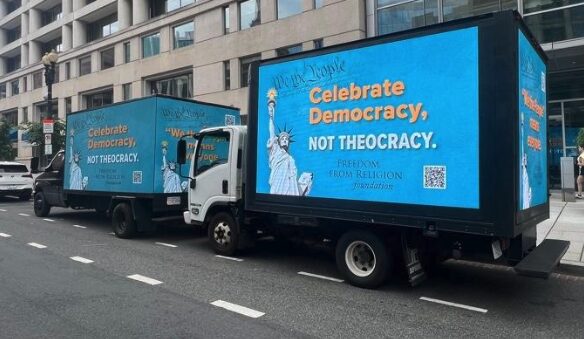
FFRF’s blog (full of photos of FFRF’s D.C. protests) took a more cathartic approach this week:
“Why poking fun at Trump’s D.C. prayerfest feeds the nonsoul.”
Because satire has always had an important role in confronting authoritarianism — especially the self-serious kind.
Secularist of the Week: Rep. Jared Huffman pushes back on Christian nation mythology

Jared Huffman and the Congressional Freethought Caucus were recognized this week for continuing to challenge one of Christian nationalism’s favorite talking points: the false claim that the United States was founded as a Christian nation.
Secularist of the Week: Rep. Jared Huffman and the Freethought Caucus
Theocrat of the Week: Mike Johnson leads Christian nationalist prayer event

House Speaker Mike Johnson earned this week’s “Theocrat of the Week” distinction for helping lead a Christian nationalist prayer event tied to the Trump-backed “Rededicate 250” rally in Washington, D.C.
Theocrat of the Week: Mike Johnson leads Christian nationalist prayer in D.C.
One final note: art still matters
In the middle of all the chaos, FFRF also highlighted something worth remembering: Culture and community still matter, too.
The Great American Songbook concert reminded audiences that human connection, creativity and joy don’t require religious gatekeeping or nationalist branding to be meaningful.
Turns out people are perfectly capable of finding awe without government-sponsored prayer rallies.
Imagine that.
Thanks for standing with us.
Whether you shared a story, spoke out in your community, tuned into Freethought Radio or Secular Spotlight, supported FFRF’s legal work, or simply helped amplify secular values in your own corner of the world — thank you.
The push to merge religion and government is organized, well-funded and relentless.
But so is the movement defending real religious freedom: the freedom to believe, the freedom not to believe and the freedom to live free from government-imposed religion.
That work only happens because individuals like you make it possible.
The post Weekly Wrap: Trump’s prayerfest fizzles, Colbert says goodbye and Christian nationalism keeps pushing forward appeared first on Freethought Now.